Job hunting, and AI
I diligently seek for new job opportunities in the last 5 months since I was laid off. The landscape of the job market has changed significantly:
- A definitive buyer’s market. It is quite common to get rejected due to that “We’ve received an overwhelming number of applications for this role”.
- The AI has been adopted ubiquitously in the recruiting cycle, and it is often a focus point for assessment.
Attention is all that is worthy
It is a known secret that employers user AI to screen resumes, — some are more explicitly about this methodology. It still surprised me that AI was replacing recruiters for initial screening. The interview experience was surreal. I logged into a website, greeted by an warm female voice and an avatar made of abstract lines. She politely asked my past experience, with follow up questions for deep dive. Those lines bounced, and danced along with the tones, showing some emotions maybe? She wrapped up in 30 minutes and stated that the recruiting team would review the report and make a decision of the next step.
I was a little bit disengaged as I could not get a cue from these dancing lines; the overall experience was not bad: AI was eloquent, and effective by skipping the smalltalk. But deep down, I felt a little bit underappreciated, — my time was not worth their attentions.
Interview or Eval
Companies also wanted to assess the candidate’s problem-solving skills with AI assistance. In one coding session, I would design strategies for some puzzle-solving problem with AI assistant in an hour. The solution consisted hundreds of lines of Python code, it was almost impossible to solve the problem by hand. I flopped miserably as I did not have time to get familiar with this particular agent; neither did I have a clear understanding why AI made these changes due to the volume of code, so I had to rely on the AI to troubleshoot by itself. I feel it was more like a eval for the agent than a code interview for me.
In another AI-assisted bug bash session, AI managed to find out the root cause in less than 5 minutes. Now what? I had to circle around the obvious answer to contribute my intelligence to the solution. It was awkward.
I understand the value of these AI-assisted interviews, the employer tried to design the interviews to emulate the working environment. But it is extremely hard to get it right thanks to the scope creep: the candidate was expected to demonstrate 10x productivity with AI assistance, which left no room for mistakes.
Culture fit
I suppose the altitude towards and/or against AI becomes a culture fit today. The companies sought for candidates who shared the same pro-AI view especially in the bar raiser session. Interestingly, we used to align candidates’ personal traits such as curiosity, open-minded; why the ephemeral opinion matters now? I interpreted this as the altitude might have such a negative impacts to the productivity that companies would overlook candidates’ other merits amid the surplus supply.
Vibe coding lessons
I seriously tried vibe coding in my downtime. Even the cheapest OpenCode Go(affiliate link) is sufficient to go far, like an interpreter/compiler for lox language with LLVM backend. Powered with coding agent, I dared to explore this uncharted territory. I could ask the agent to debug for me if I got stuck. You may checkout the development journals for my learning.
AI could help you get there much sooner if you have a clear vision. The development of history map stalled as I was stuck with the polygon walking, and voilà:
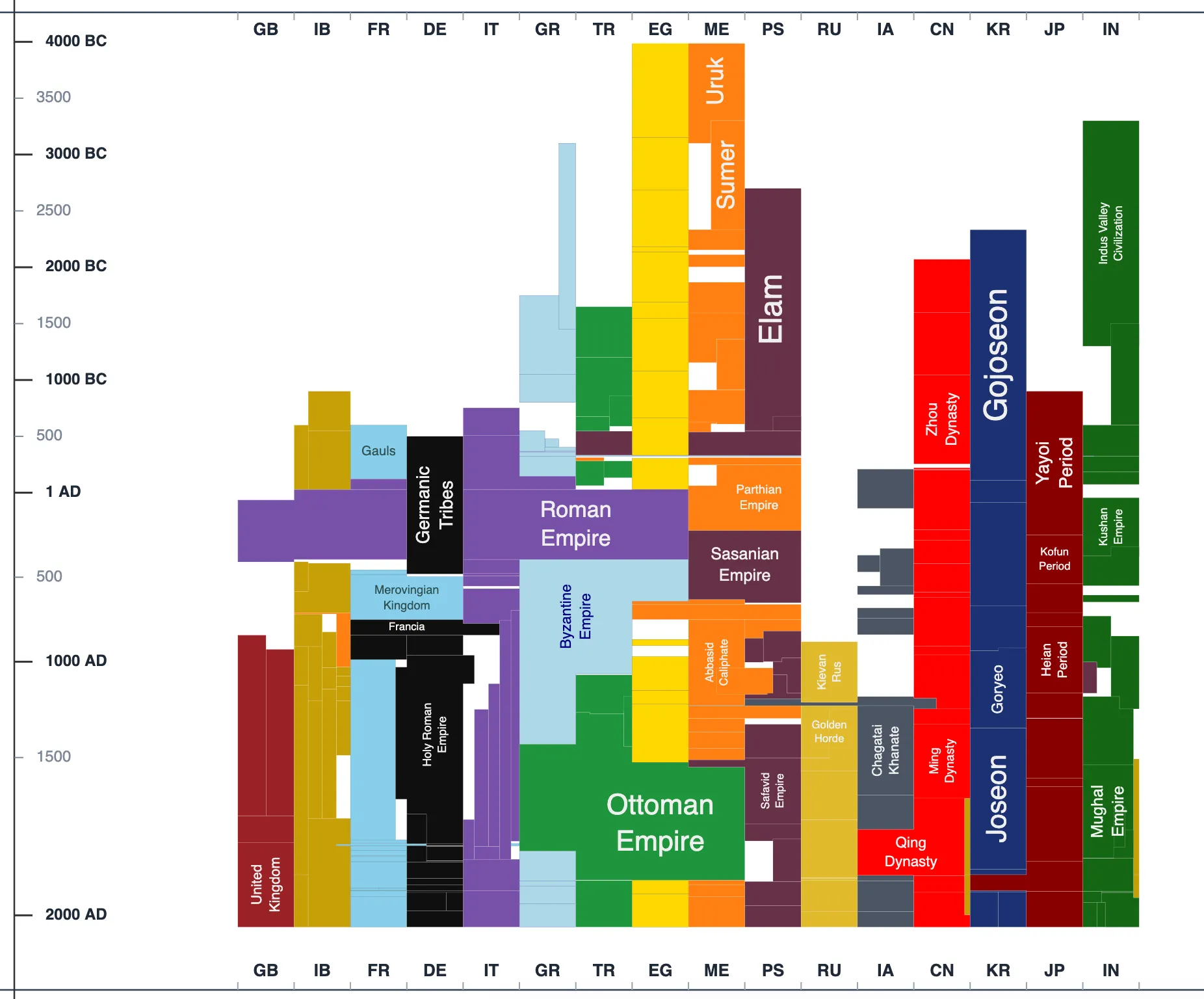
But AI is not an oracle to tell me where the project heads to; I have to figure out how to integrate wars, trade network, scientific discoveries, and other deciding factors into the charts. 😅